 Ballista
Density Altitude: One Number for the Air, and Where It Stops Being Enough
What density altitude measures, how it is computed from pressure, temperature and humidity, what 5,000 and 10,000 ft do to your come-ups, and why two days with the same DA can still need different holds at 1,000 yards.
Take a 6.5 Creedmoor zeroed at sea level to a range at 10,000 ft on a standard day. At 1,000 yards it now needs 1.19 mil less elevation than it did at home. Dial the sea-level come-up and the bullet lands about 43 inches high. A .308 is off by 2.37 mil, about 85 inches. One number describes the air that made that difference: density altitude. It packs pressure, temperature and humidity into a single figure. It also leaves out one thing a long-range shooter should know about.
What density altitude measures
Drag on a bullet is proportional to the density of the air it pushes through. Halve the density and, at the same speed, you halve the drag. Pressure, temperature and humidity matter to the bullet only through what they do to density, plus a second effect through the speed of sound that we come back to below.
Density altitude is the altitude in the ICAO standard atmosphere where the air would have the density you have now. A DA of 5,000 ft means your air is as thin as standard air at 5,000 ft, wherever you are standing. A hot afternoon at a low range can have a higher DA than a cold morning in the mountains.
The same shot at 0, 5,000 and 10,000 ft
| Range, yd | 6.5: DA 0 | 6.5: DA 5,000 | 6.5: DA 10,000 | .308: DA 0 | .308: DA 5,000 | .308: DA 10,000 |
|---|---|---|---|---|---|---|
| 300 | 1.22 | 1.19 | 1.16 | 1.42 | 1.36 | 1.32 |
| 600 | 3.92 | 3.74 | 3.59 | 4.79 | 4.48 | 4.23 |
| 800 | 6.16 | 5.80 | 5.50 | 7.87 | 7.19 | 6.66 |
| 1,000 | 8.85 | 8.18 | 7.66 | 11.94 | 10.57 | 9.56 |
At 600 yd the difference between sea level and 5,000 ft is 0.18 mil for the 6.5, about two 0.1 mil clicks. At 1,000 yd it is 0.66 mil. Thin air lets the bullet keep its speed, so it gets there sooner and falls less on the way.
So a rule like “so many tenths of a mil per 1,000 ft of DA” is a fair way to check a solution in your head, if you know the figure for your load at your distance. Over the full 10,000 ft the 6.5 loses 13% of its sea-level come-up at 1,000 yd and the .308 20%. The .308 changes faster because its bullet gets close to the speed of sound, where drag is highest, and thin air keeps it away from it longer. At sea level it drops below Mach 1.2 at about 790 yd. At 10,000 ft that happens at about 1,140 yd. The transonic article shows where each bullet crosses it.
How density altitude is computed
The calculation has two steps.
First, density from the three readings. The air is treated as a mix of dry air and water vapor. Each part follows the ideal gas law. Dry air contributes (station pressure − vapor pressure) ÷ (287.06 × T). Water vapor contributes vapor pressure ÷ (461.5 × T), with T in kelvin and pressure in pascals. The vapor pressure comes from the relative humidity times the saturation pressure at that temperature. The pressure here must be station pressure, the absolute pressure where you stand. The station pressure article shows what happens when it isn’t.
Second, find that density in the standard atmosphere. In the ICAO model the density falls with altitude in a known way, so the step can be inverted:
DA = 145,442 ft × [1 − (ρ ÷ 1.225)^0.2350]
Here ρ is your air density in kg/m³ and 1.225 kg/m³ is standard sea-level density. The constants come straight from the standard atmosphere: 288.15 K at sea level, cooling 6.5 K per kilometer.
A worked case: dry air at 95°F and 27.57 inHg station pressure has a density of 1.0555 kg/m³. That’s 86.2% of standard sea-level density, which the formula turns into 5,000 ft.
Same density altitude, different air
If density altitude were the whole story, every kind of air with the same DA would give the same come-ups. Here are three, all at a DA of 5,000 ft: a cold day high in the mountains, a standard day, and a hot day much lower down. Pressure altitude is the height at which the standard atmosphere has your station pressure, so it tells you roughly how high each range sits.
| Air temperature | Station pressure, inHg | Pressure altitude, ft | Speed of sound, fps | 6.5 at 600 | 6.5 at 1,000 | .308 at 600 | .308 at 1,000 |
|---|---|---|---|---|---|---|---|
| 20°F | 23.84 | 6,100 | 1,074 | 3.73 | 8.15 | 4.46 | 10.50 |
| 41°F (standard) | 24.90 | 5,000 | 1,097 | 3.74 | 8.18 | 4.48 | 10.57 |
| 95°F | 27.57 | 2,200 | 1,155 | 3.76 | 8.27 | 4.52 | 10.75 |
Out to 600 yd the three agree within 0.06 mil, less than one 0.1 mil click. For most shooting, DA really is one number for the air.
At 1,000 yd they don’t agree. The hot day needs 0.12 mil more than the cold one for the 6.5 and 0.25 mil more for the .308. That’s 9 inches at the target for the .308, enough to matter on a 12-inch plate.
The cause is the speed of sound. Density is the same in all three, but sound travels faster in warm air: 1,155 fps at 95°F against 1,074 fps at 20°F. Drag depends on the bullet’s Mach number, its speed divided by the speed of sound, and on the G7 reference curve the drag coefficient rises as Mach falls all the way from the muzzle down to about Mach 1.05. On the hot day the same bullet speed is a lower Mach number, so the bullet feels a little more drag at every point. At 1,000 yd the .308 is at Mach 1.07 on the hot day and Mach 1.18 on the cold one, and it crosses Mach 1.2 at 870 yd instead of 980 yd.
So use density altitude for what it is good at, and give your solver the temperature too. A solver that takes DA alone has to assume a temperature to get the speed of sound, and on a day far from that assumption the far targets show it.
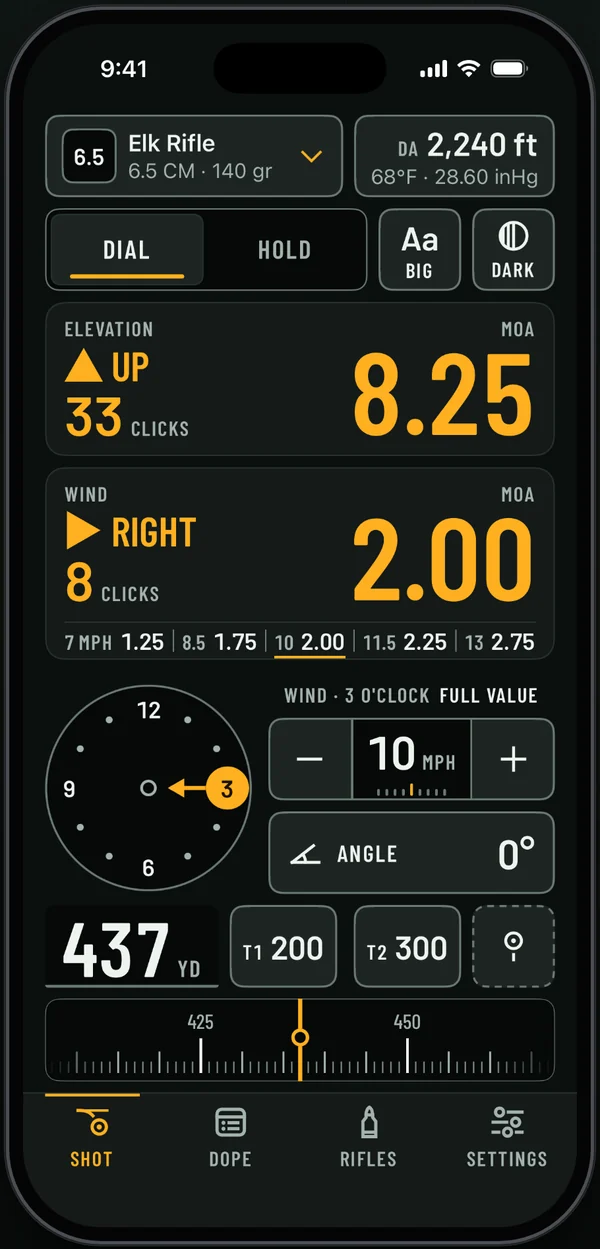
In Ballista the density altitude sits at the top of the Shot screen and again at the top of the Air sheet, computed from whatever you entered: phone barometer, a meter’s station pressure, a weather report or a standard day. If your meter gives you density altitude, pick Density altitude as the source and type the temperature with it. Ballista then rebuilds air with that density at that temperature, so the speed of sound matches your day.
Using density altitude in the field
- Learn your come-up change per 1,000 ft of DA at your longest common distance. For the 6.5 at 1,000 yd it is about 0.12 mil. It lets you sanity-check any solution.
- Use station pressure, temperature and humidity from where you are shooting. DA built from a weather report’s sea-level pressure is wrong by thousands of feet at altitude.
- Give the solver the real temperature even when you enter DA. It’s worth less than a click at 600 yd and up to 0.25 mil at 1,000 yd.
- Re-check the air when it changes. A morning-to-afternoon swing from 60°F to 90°F at the same pressure raises DA by 1,900 ft. The temperature article shows what that does to your come-ups.
Sources
- International Civil Aviation Organization, Manual of the ICAO Standard Atmosphere (Doc 7488). Sea-level pressure, temperature, density and lapse rate used in the density-altitude formula.
- Bryan Litz, Applied Ballistics for Long-Range Shooting, 3rd ed., Applied Ballistics LLC, 2015. Atmospheric effects on trajectories.
- Robert L. McCoy, Modern Exterior Ballistics, Schiffer Publishing, 1999. Drag as a function of Mach number and air density.
- Every number in this article: Ballista engine (BallistaCore point-mass solver), inputs in the box above. See how we compute.