 Ballista
Transonic Flight: Where Your Bullet Goes Subsonic and Why Groups Open Up
Where a 6.5 Creedmoor and a .308 drop below Mach 1.2 and Mach 1 from sea level to 10,000 ft, what the G7 drag curve does near the speed of sound, and what really extends your supersonic range.
A .308 with a 175 gr match bullet at 2,600 fps drops below Mach 1.2 at 790 yd on a standard day at sea level, and goes subsonic at 970 yd. Take it to a 10,000 ft range and those points move out to 1,140 and 1,380 yd. That’s 350 yards of extra supersonic flight from the air alone, more than a 100 fps faster load buys you at sea level.
What happens to drag near Mach 1
A bullet’s drag coefficient isn’t constant. It depends on the Mach number, the bullet’s speed divided by the local speed of sound. Here is the G7 reference curve, the one long boat-tail match bullets are usually rated against, plotted straight from the table the Ballista engine uses.
Read it from right to left, the way a bullet experiences it. Leaving the muzzle above Mach 2, drag is moderate and rises slowly as the bullet slows. Near Mach 1.2 the climb steepens. Between Mach 1.0 and Mach 1.1 the curve sits at its peak, 0.404 at Mach 1.05. That is where the bow shock in front of the bullet forms and strengthens. Below Mach 1 the drag coefficient drops away quickly: at Mach 0.9 it is 0.1464, at Mach 0.8 0.1242.
Two things make this zone hard to predict. First, the G7 BC fits one number to a fixed curve shape. No real bullet has exactly the G7 shape, and any mismatch counts most where the curve changes fastest. Second, as the bullet slows through Mach 1 the shock waves move along its body. The forces on it shift, and a bullet that was stable in supersonic flight can yaw. That can open groups up and string them vertically just as the solver’s prediction gets less certain.
That’s why Ballista treats Mach 1.2 as the practical end of supersonic flight. At sea level on a standard day, Mach 1.2 is 1,340 fps.
Where each bullet crosses Mach 1.2 and Mach 1.0
| Density altitude | 6.5: Mach 1.2 | 6.5: Mach 1.0 | .308: Mach 1.2 | .308: Mach 1.0 |
|---|---|---|---|---|
| 0 ft | 1,140 | 1,380 | 790 | 970 |
| 2,500 ft | 1,250 | 1,510 | 870 | 1,060 |
| 5,000 ft | 1,360 | 1,640 | 950 | 1,160 |
| 7,500 ft | 1,500 | 1,800 | 1,040 | 1,260 |
| 10,000 ft | 1,640 | 1,970 | 1,140 | 1,380 |
Three things in this table are worth knowing:
The 6.5 stays supersonic much longer. At sea level it reaches Mach 1.2 at 1,140 yd, 350 yd beyond the .308. It starts 110 fps faster, and its higher BC, 0.326 against 0.243, keeps more of that speed.
Altitude is worth more than you’d think. The first 2,500 ft of density altitude pushes the 6.5’s Mach 1.2 point out by 110 yd, and the step from 7,500 to 10,000 ft by 150 yd. Part of that is thinner air, and part is that standard air higher up is colder, with a slower speed of sound: 1,077 fps at 10,000 ft against 1,116 at sea level. The same bullet speed is a higher Mach number there.
Temperature moves it even at the same density altitude. At DA 5,000 ft the 6.5 crosses Mach 1.2 at 1,250 yd on a 95°F day and 1,410 yd on a 20°F day. The .308 crosses at 870 and 980 yd. Warm air carries sound faster, so the bullet hits Mach 1.2 at a higher speed, sooner. The density altitude article shows what that does to come-ups.
What extends your practical supersonic range
Adding 100 fps of muzzle velocity moves the Mach 1.2 point out by 70 yd for the 6.5 and 50 yd for the .308, at sea level. Shooting at 10,000 ft instead of sea level moves it by 500 and 350 yd. You can’t choose the air, but you can know what it does: a load that is marginal at 1,000 yd at home may be comfortably supersonic at a mountain range, and the reverse on a cold day at the coast.
A better bullet does as much or more. A G7 BC 10% higher moves the point out by 110 yd for the 6.5 and 80 yd for the .308. The velocity versus BC article shows how errors in each grow with range.
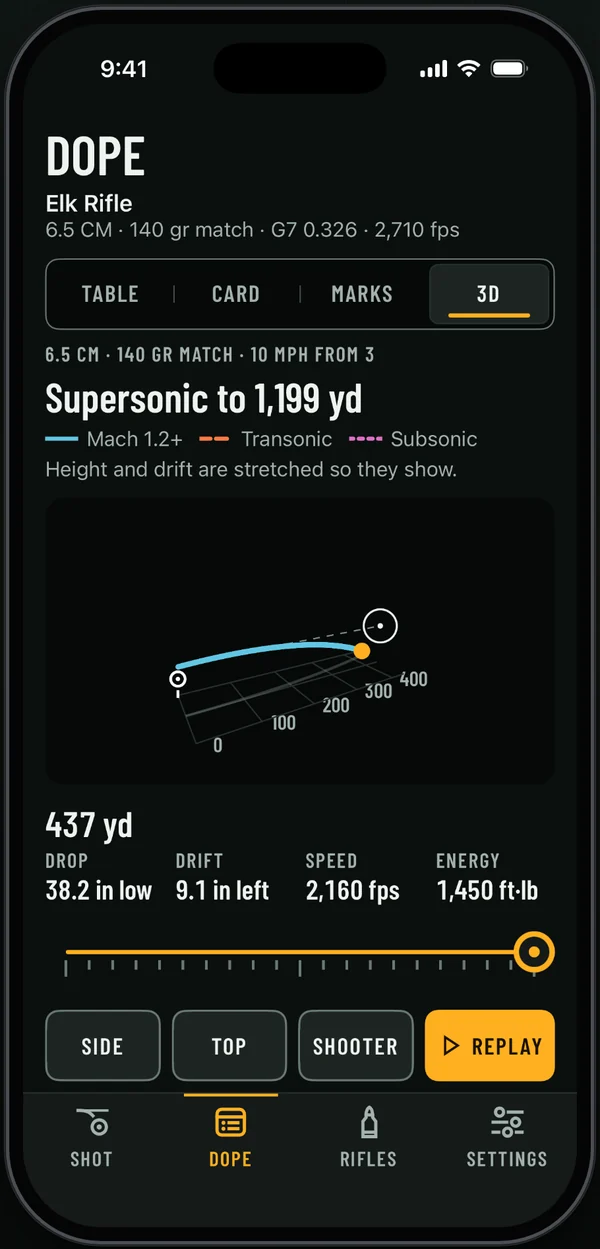
Ballista marks the same boundary everywhere it shows a trajectory. The 3D view’s header reads “Supersonic to” a distance, the Mach 1.2 point in today’s air. The DOPE table puts a “Transonic · less certain past here” band where the bullet drops below Mach 1.2 and a “Subsonic” band below Mach 1. Printed cards mark those rows “* below Mach 1.2: less certain”.
Working near the transonic zone
- Know your Mach 1.2 distance for the air you shoot in. Check it again at a new altitude or in a big temperature change.
- Treat solutions past it as estimates. Confirm with live fire and true the drag at that distance, not the velocity. The truing article explains the difference.
- Expect wider groups and more vertical past it, and keep the target size realistic.
- If you need more supersonic range, compare a higher-BC bullet with a faster load. Here 10% more BC did more than 100 fps more velocity.
Sources
- Robert L. McCoy, Modern Exterior Ballistics, Schiffer Publishing, 1999. Standard drag functions (the G7 table plotted above) and drag in transonic flight.
- Bryan Litz, Applied Ballistics for Long-Range Shooting, 3rd ed., Applied Ballistics LLC, 2015. The G7 standard and transonic effects on long-range bullets.
- International Civil Aviation Organization, Manual of the ICAO Standard Atmosphere (Doc 7488). Standard temperature and speed of sound at altitude.
- Every number in this article: Ballista engine (BallistaCore point-mass solver), inputs in the box above. See how we compute.