 Ballista
Shooting Uphill and Downhill: The Rifleman's Rule and Where It Stops Working
Why you hold less on any slope, why uphill and downhill aren't quite the same, and how far the rifleman's rule and the cosine rule drift from a full solution at 15, 30 and 45 degrees out to 900 yards.
Every shooter learns early that you hold less on a steep shot, uphill or downhill. Fewer learn why, or how much the standard shortcuts give away. We ran the full inclined-fire solution against the two common rules for a 6.5 Creedmoor at 15, 30 and 45 degrees. The rules hold up better than their reputation on moderate slopes and fall apart faster than people expect on steep ones.
Why a slope needs less elevation
Your come-up does two jobs. It covers how far gravity pulls the bullet away from the line of sight during the flight, minus the rise the rifle already built in when you zeroed it. On a slope, gravity still points straight down, but only part of it acts across the line of sight. That part is g × cos θ, where θ is the slope angle. The rest acts along the bullet’s path: it slows the bullet slightly when you shoot uphill and speeds it slightly downhill.
The two shortcuts
The rifleman’s rule: range the target, multiply the slant range by cos θ, and use your flat-ground come-up for that horizontal distance. It’s simple, and it’s the rule most hunting guides teach.
The cosine rule: use the come-up for the full slant range and multiply that come-up by cos θ.
Both are approximations. The rifleman’s rule uses a shorter time of flight than the bullet really has, so it slightly under-corrects. The cosine rule scales the zero rise along with the gravity drop, so it over-corrects. The full solution sits between them.
| Slant range, angle | Flat come-up | Uphill, full solution | Downhill, full solution | Rifleman's rule | Cosine × slant come-up |
|---|---|---|---|---|---|
| 300 yd, 15° | 1.22 | 1.15 | 1.15 | 1.15 | 1.18 |
| 300 yd, 30° | 1.22 | 0.93 | 0.93 | 0.92 | 1.06 |
| 300 yd, 45° | 1.22 | 0.58 | 0.58 | 0.59 | 0.87 |
| 500 yd, 15° | 2.93 | 2.81 | 2.79 | 2.78 | 2.83 |
| 500 yd, 30° | 2.93 | 2.41 | 2.39 | 2.32 | 2.54 |
| 500 yd, 45° | 2.93 | 1.78 | 1.76 | 1.65 | 2.07 |
| 700 yd, 15° | 4.99 | 4.80 | 4.76 | 4.72 | 4.82 |
| 700 yd, 30° | 4.99 | 4.21 | 4.15 | 3.98 | 4.32 |
| 700 yd, 45° | 4.99 | 3.25 | 3.18 | 2.89 | 3.53 |
| 900 yd, 15° | 7.44 | 7.19 | 7.11 | 7.03 | 7.19 |
| 900 yd, 30° | 7.44 | 6.37 | 6.23 | 5.91 | 6.44 |
| 900 yd, 45° | 7.44 | 5.02 | 4.87 | 4.29 | 5.26 |
Where the rules work
At 15° or less, either rule is fine. The full solution differs from the rifleman’s rule by at most 0.16 mil anywhere out to 900 yd. That’s less than one 0.1 mil click inside about 700 yd. Most hunting shots are taken at angles like this.
At 30° the error becomes a click or two. At 700 yd downhill the rifleman’s rule is 0.17 mil low and the cosine rule 0.17 mil high. That’s 4.2 in and 4.4 in at the target: most of the way from the center to the edge of a 12-inch plate, before any other error.
At 45° the rules stop being usable at distance. At 900 yd the full solution needs 5.02 mil uphill and 4.87 mil downhill. The rifleman’s rule gives 4.29, the cosine rule 5.26. Steep mountain shots at long range need a real solution.
Uphill and downhill differ, but only slightly. At 900 yd and 45° the uphill shot needs 0.15 mil more than the downhill one, because the bullet is slowed by the along-path part of gravity and is in the air longer. At 15° the difference is 0.08 mil or less out to 900 yd.
The hunting case that matters most
The common real mistake isn’t picking the wrong rule. It’s using the flat-ground come-up and ignoring the angle. Take a buck 400 yd away, 30° below you. The flat come-up is 2.04 mil. The full solution needs 1.62. Dialing the flat number puts the bullet 6.0 in high: outside an 8-inch vital zone aimed at its center. Using the rifleman’s rule instead leaves you 0.4 in from the full solution.
So the rule of thumb is worth knowing. The angle is what you must not skip.
Measuring the angle
A few degrees of angle error barely matters on a gentle slope, because cos θ changes slowly near 0°: cos 10° is 0.985. On a steep slope it matters more: cos 40° is 0.766 and cos 45° is 0.707. So measure steep angles rather than guessing them.
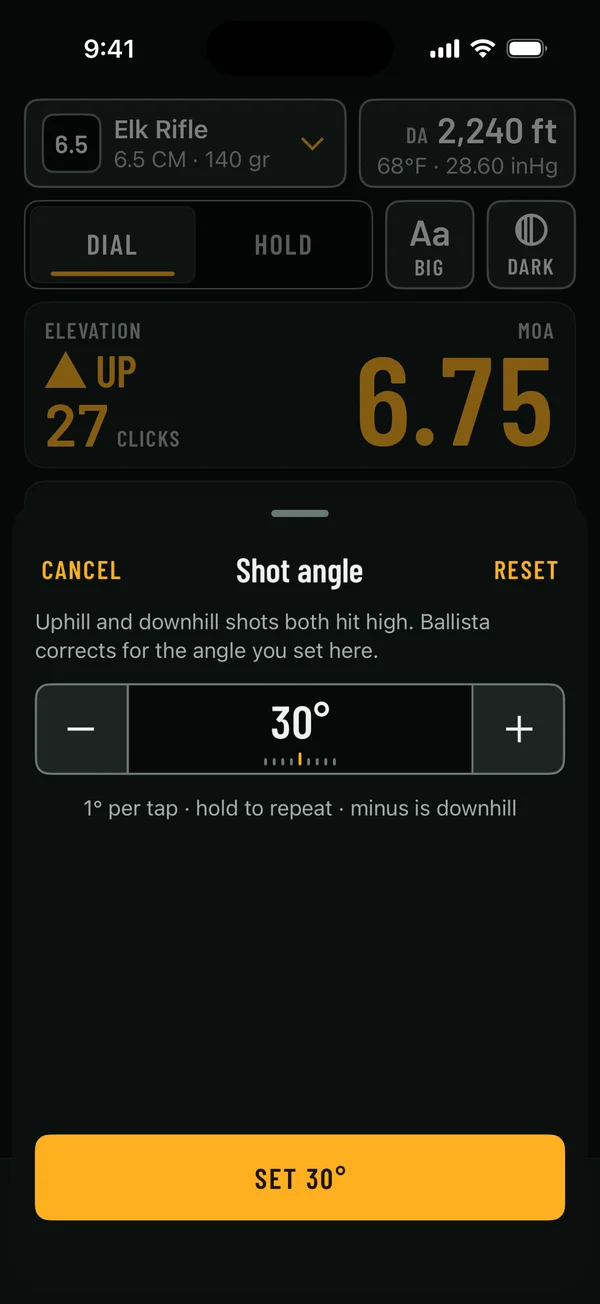
In Ballista you can set the angle with the stepper or measure it. Tap “Measure with iPhone”, lay the phone flat along the scope or barrel, aim at the target, and tap “Use”. The app reads the phone’s tilt, rounds it to a whole degree and solves the full inclined trajectory with that angle. It doesn’t use either rule above. It never reads the angle on its own; you choose when to measure.
Summary
- Below about 15°, any method works. Use the rifleman’s rule if you don’t have a solver.
- At 30°, expect a click or two of error from either rule beyond 500 yd.
- At 45° and long range, use a full solution. At 900 yd the rifleman’s rule is off by 0.58 mil and the cosine rule by 0.39 mil downhill.
- Ignoring the angle is far worse than any rule: at 400 yd and 30° it puts you 6 in high.
- Zero your rifle on flat ground. The full solution starts from a flat zero.
Sources
- Bryan Litz, Applied Ballistics for Long-Range Shooting, 3rd ed., Applied Ballistics LLC, 2015. Inclined fire and the rifleman’s rule.
- Robert L. McCoy, Modern Exterior Ballistics, Schiffer Publishing, 1999. Point-mass trajectory with the line of sight inclined.
- Every number in this article: Ballista engine (BallistaCore point-mass solver), inputs in the box above. See how we compute.