 Ballista
Muzzle Velocity or BC: Which Error Costs You More?
A 25 fps velocity error and a 5% BC error, solved side by side to 1,000 yards: where each one dominates, what your chronograph's SD does to vertical, and why truing at 600 yards can still miss at 1,000.
Every ballistic solution rests on two numbers the shooter supplies: how fast the bullet leaves the muzzle and how well it holds that speed. Both come with error. The box velocity was measured in someone else’s barrel, and the ballistic coefficient was measured on someone else’s lot of bullets, or calculated. Which of the two deserves your attention depends on the range you shoot, and the crossover is closer than most shooters expect.
Same-sized mistakes, solved side by side
We gave each rifle two plausible errors: a muzzle velocity 25 fps lower than the calculator thinks, and a G7 BC 5% lower. Then we asked the Ballista engine how much extra elevation each error needs at each range.
| Range, yd | 6.5 come-up | 6.5: −25 fps | 6.5: −5% BC | .308 come-up | .308: −25 fps | .308: −5% BC |
|---|---|---|---|---|---|---|
| 300 | 1.22 | 0.03 | 0.01 | 1.42 | 0.04 | 0.02 |
| 500 | 2.93 | 0.06 | 0.04 | 3.52 | 0.08 | 0.07 |
| 600 | 3.92 | 0.09 | 0.07 | 4.79 | 0.11 | 0.12 |
| 700 | 4.99 | 0.11 | 0.10 | 6.23 | 0.14 | 0.18 |
| 800 | 6.16 | 0.13 | 0.14 | 7.87 | 0.18 | 0.27 |
| 900 | 7.44 | 0.16 | 0.19 | 9.76 | 0.23 | 0.40 |
| 1,000 | 8.85 | 0.19 | 0.26 | 11.94 | 0.29 | 0.56 |
Three things stand out.
Closer in, velocity is the bigger problem. At 500 yd the 25 fps error costs the 6.5 0.06 mil and the BC error only 0.04. Drag hasn’t had time to matter much yet, but a slower bullet starts falling behind from the first yard.
Beyond the crossover, BC takes over and keeps accelerating. At 1,000 yd the 5% BC error costs the .308 0.56 mil, nearly twice the velocity error. That’s a 20-inch miss from a coefficient that differs from the box by one part in twenty.
The lower-BC bullet crosses over sooner. The .308 bullet sheds speed faster, so its drag error compounds earlier. It drops below Mach 1.2, where the transonic zone begins, at about 790 yd in this air. There the drag curve steepens and small BC differences grow quickly.
What your chronograph’s SD does to vertical
The same numbers explain vertical dispersion. For the 6.5 each fps of velocity changes the impact by 0.07 in at 600 yd and 0.28 in at 1,000. A load with a 10 fps standard deviation therefore adds about 2.8 in of vertical spread (one SD) at 1,000 yd on its own, before the rifle’s own precision. Halving the SD halves that number. This is why long-range handloaders care about single-digit SDs and why short-range shooters rarely need to.
Truing: fix the right number at the right distance
When your real drops don’t match the calculator, you true it: adjust one input until the prediction matches what you saw. The question is which input. The trap is that both errors look the same at one distance.
Say the real BC of your bullets is 5% lower than published, but you true velocity at 600 yd. The engine finds a muzzle velocity 19 fps lower that matches the 600 yd drop exactly. Now look further out:
| Range, yd | Impact vs aim, MIL | Impact vs aim, in |
|---|---|---|
| 600 | 0.00 | 0.0 |
| 700 | -0.02 | -0.4 |
| 800 | -0.04 | -1.1 |
| 900 | -0.07 | -2.3 |
| 1,000 | -0.11 | -4.1 |
The 600 yd error is gone, but the shot still lands 4.1 in low at 1,000. A velocity fix can’t reproduce a drag problem because the two errors grow at different rates. The cure is to true with the input that actually drives the error at the distance you observed:
- Use velocity when your observation is at a range where the bullet is still well supersonic. The 6.5 is at Mach 1.73 at 600 yd here, so a 600 yd check is a velocity check.
- Use drag (BC) when the observation is far enough that the bullet has slowed toward the transonic zone, and confirm it at a second distance.
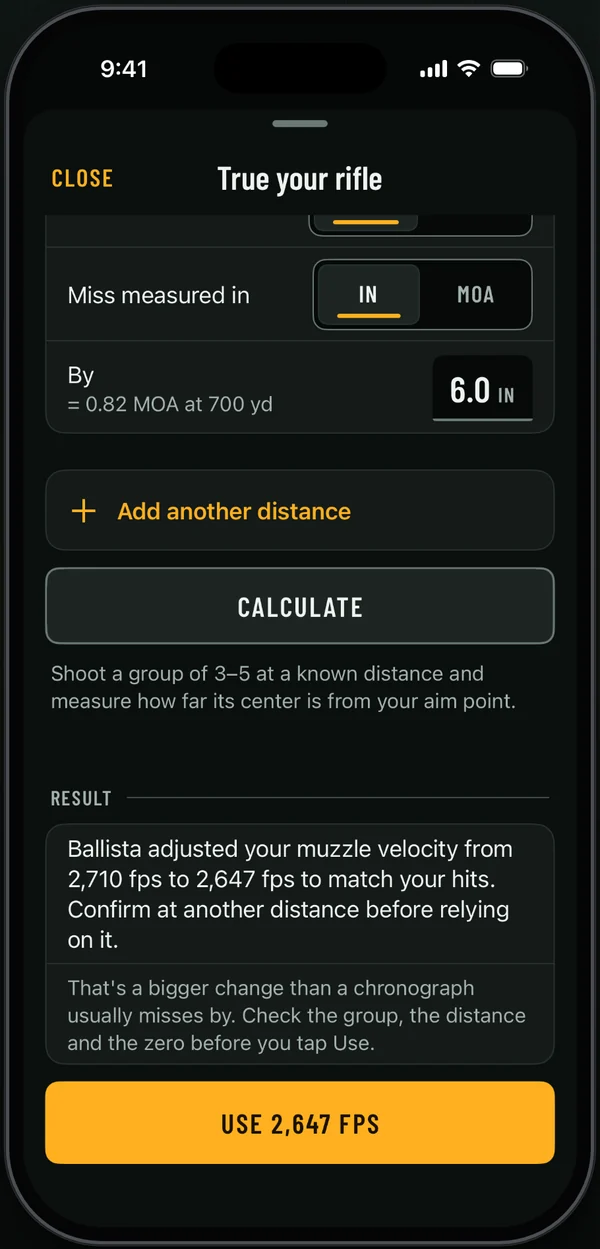
Ballista follows the same rule automatically. When you enter where your shots landed, it trues muzzle velocity if your farthest observation was taken above Mach 1.2 and drag if it was slower. If the profile’s velocity comes from a chronograph, it trusts that number and trues the BC. It accepts up to three distances so a velocity fix at one range can be checked against a far one.
What to do with this
- Measure velocity before you worry about BC. A chronograph reading from your rifle removes the error that dominates where most shots are taken.
- Use a G7 BC for long-range match bullets. A single G7 number tracks how these bullets really slow down far better than G1. The G1 vs G7 article shows why.
- True velocity at a middle distance, then confirm at long range. If the far distance still misses after a velocity true, the problem is drag. Change BC, not velocity again.
- Expect the crossover to move. Thin air delays the point where BC dominates. For the 6.5 it moves from about 760 yd at sea level to about 920 yd at a 6,000 ft density altitude. Dense, cold air brings it closer.
Sources
- Bryan Litz, Applied Ballistics for Long-Range Shooting, 3rd ed., Applied Ballistics LLC, 2015. G7 standard, BC measurement, velocity and BC sensitivity.
- Robert L. McCoy, Modern Exterior Ballistics, Schiffer Publishing, 1999. Drag functions and the point-mass trajectory model.
- Every number in this article: Ballista engine (BallistaCore point-mass solver), inputs in the box above. See how we compute.