 Ballista
Truing a Ballistic Solver: Which Input, Which Distance, How Many Shots
Step-by-step truing at one to three distances: where velocity truing works and where drag truing has to take over, how many shots a group needs, and how a two-distance true fixes a .308 to 1,000 yards.
Read your group at 300 yards a tenth of a mil wrong and a velocity true will move your 6.5 Creedmoor’s muzzle velocity by 86 fps. Make the same reading error at 600 yards and it moves 30 fps. Try to true the BC at 600 from the same mistake and you’d shift it by 8.1%. Truing works when you shoot at the distance where the input you’re fixing actually controls the drop, with a group big enough to locate its center. Here is how to pick both.
Velocity first, then drag
Truing means changing one input until the solver’s elevation matches what it took to hit. Velocity and BC both lower the drop, but they grow at different rates with range. The velocity versus BC article shows why a velocity fix can match one distance and still miss at another. The practical rule that follows:
- True velocity where the bullet is still fast. There drag barely changes the drop and a velocity error explains almost all of it.
- True drag (BC) afterwards, where the bullet has slowed toward the speed of sound. There the BC controls the drop and the velocity is already right.
A workable plan: velocity at the farthest distance where the bullet is still at Mach 1.5 or faster, kept between 300 and 700 yd, and drag where it slows to about Mach 1.1. In standard sea-level air that’s:
- 6.5 Creedmoor: still Mach 1.5 at 800 yd, so velocity at 700 yd (Mach 1.62); drag at 1,275 yd.
- .308: velocity at 550 yd (Mach 1.51); drag at 900 yd.
The 6.5 holds its speed so well that drag truing needs a range most shooters don’t have at sea level. In thin air the bullet slows later still. With that rifle, true velocity carefully and use the maker’s G7 BC until you can confirm it far out.
Which distance: how much your measurement error is worth
Your observation is never perfect. A group center you misread by 0.1 mil turns into a velocity or BC error. How big depends on the distance.
| Range, yd | 6.5: fps per 0.1 mil | 6.5: BC per 0.1 mil | .308: fps per 0.1 mil | .308: BC per 0.1 mil |
|---|---|---|---|---|
| 300 | 86 | 43.7% | 71 | 27.1% |
| 400 | 55 | 21.8% | 44 | 13.1% |
| 500 | 39 | 12.7% | 31 | 7.4% |
| 600 | 30 | 8.1% | 23 | 4.6% |
| 700 | 23 | 5.5% | 18 | 3.0% |
| 800 | 19 | 3.8% | 14 | 2.0% |
| 900 | 16 | 2.8% | 11 | 1.4% |
| 1,000 | 13 | 2.1% | 9 | 1.0% |
| 1,100 | 11 | 1.6% | 7 | 0.7% |
| 1,200 | 9 | 1.2% | 6 | 0.6% |
| 1,300 | 8 | 0.9% | 5 | 0.5% |
Two patterns matter. Velocity truing gets more trustworthy with distance: a 0.1 mil reading error is worth 86 fps at 300 yd for the 6.5 and 23 fps at 700. Inside 300 yd, velocity truing amplifies your mistakes. BC truing is hopeless close in: at 600 yd the same 0.1 mil is worth 8.1% of BC. It only drops to one or two percent per 0.1 mil near the transonic zone, the far truing distances above.
How many shots
A single shot tells you about the shot, not the rifle. The center of a group is what moves with velocity and BC, and it settles down with the square root of the number of shots.
Take a rifle that averages 1 MOA for 5-shot groups. A 5-shot group’s extreme spread averages 3.06 times the per-axis standard deviation (we checked it with 200,000 simulated groups), so each shot lands with a standard deviation of 0.33 MOA up and down. The uncertainty of the group’s vertical center is then 0.33 MOA for one shot, 0.19 MOA for three, 0.15 for five and 0.10 for ten. At 600 yd, where one MOA of elevation is worth 86 fps for the 6.5, that’s about 16 fps of uncertainty with three shots and 13 with five.
So shoot at least three, preferably five, and measure the group’s center from your aim point, not the closest hole. If the miss is smaller than what the group itself can explain, don’t true at all. A workable line is half a MOA, which at 600 yd is 43 fps for the 6.5. Below that, shoot another group before changing anything.
One to three distances: a worked example
Take a .308 whose real velocity is 2,560 fps instead of the published 2,600, and whose bullets have a BC 4% below the box. We solved the real rifle, read the exact elevation it needs at each truing distance, and trued the solver step by step.
- Velocity at 550 yd. The engine finds that 2,541 fps matches the 550 yd drop with the published BC. That’s 19 fps below the real velocity, because the velocity absorbed the drag error too.
- Drag at 900 yd, keeping 2,541 fps. The matching BC is G7 0.239, against 0.233 real.
| Range, yd | Published numbers | After velocity truing at 550 yd | After drag truing at 900 yd too |
|---|---|---|---|
| 300 | -0.07 | 0.01 | 0.02 |
| 500 | -0.19 | 0.01 | 0.03 |
| 550 | -0.23 | 0.00 | 0.03 |
| 700 | -0.38 | -0.03 | 0.03 |
| 800 | -0.52 | -0.08 | 0.02 |
| 900 | -0.70 | -0.14 | 0.00 |
| 1,000 | -0.93 | -0.23 | -0.03 |
Neither trued number is the real one. The pair of them still reproduces the real rifle within 0.03 mil (1.1 in) everywhere from 100 to 1,000 yd, because each was fitted where it controls the drop. A third distance is a check: shoot between or beyond the first two, and if it agrees, stop. If it doesn’t, the cause is probably not velocity or BC.
What truing can’t fix
Truing adjusts velocity or BC to absorb whatever else is wrong. A wrong range, a turret that moves more or less than its marks, a bumped zero, sea-level pressure typed as station pressure or a mismeasured sight height will all be “fixed” by a wrong velocity or BC that works only at that one distance. Before you accept a large change, check the range, the zero, the scope tracking and the air.
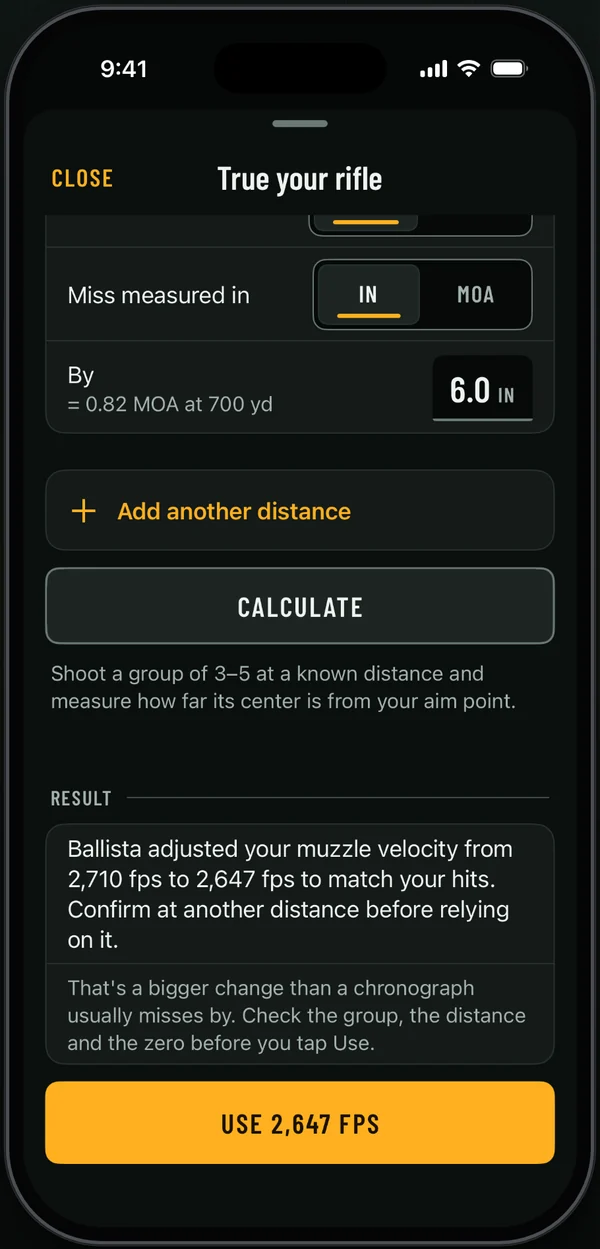
In Ballista, “True muzzle velocity” opens a sheet that does this from your shots. It suggests a velocity distance and a BC distance by the Mach 1.5 and 1.1 rule above. You enter the distance, what you dialed, and whether the group landed low or high and by how much, and you can add up to three distances. On Auto it trues velocity if your farthest distance was at Mach 1.2 or faster, and BC beyond that; with a chronographed velocity it trues BC. A miss under half a MOA gets “Shoot another group before changing anything.” It warns when your distances disagree by more than 0.3 mil after truing, lists other inputs that could explain the miss, and keeps a truing history you can undo.
A truing routine
- Chronograph if you can, so velocity starts out measured.
- Confirm the zero, the range and the air you entered.
- Shoot 3 to 5 shots at the velocity distance, measure the group center, and true velocity.
- Shoot 3 to 5 shots near Mach 1.1 and true drag, keeping the new velocity.
- Check at a third distance. Write the date and conditions on your DOPE card.
Sources
- Bryan Litz, Applied Ballistics for Long-Range Shooting, 3rd ed., Applied Ballistics LLC, 2015. Velocity and BC sensitivity, G7 BCs and the transonic zone.
- Every number in this article: Ballista engine (BallistaCore point-mass solver), inputs in the box above. Truing done by solving the engine on grids of velocity and BC and interpolating the value that matches the observed elevation. See how we compute.