 Ballista
Guides · Questions shooters ask
My Drops Don't Match the App: Read the Input Mistake From the Shape of the Miss
Seven common input mistakes solved against a 6.5 Creedmoor's true trajectory to 1,000 yards. They fall into three shapes, and your miss at two distances tells you which one you have before you true anything.
A 6.5 Creedmoor whose turret moves 5% short hits 1.5 MOA low at 1,000 yards. The same rifle with a muzzle velocity 50 fps slower than the app thinks hits 1.4 MOA low. At 300 yards the two misses are 0.21 and 0.21 MOA. You can’t tell them apart from the target. But you can tell either of them from a zero problem or a drag problem, and that’s the useful part. One of the most common questions on shooting forums is some version of “my drops don’t match the app.” Before you true anything, the shape of the miss tells you which input to look at.
Why truing first can hide the problem
Truing adjusts muzzle velocity or BC until the app matches what you saw. It will match any miss at one distance, whatever caused it. If the real cause was a mistyped sight height, the trued velocity now carries that mistake, and it shows up again at a different distance or in different air. The truing guide covers how to true. This one covers what to check before you do.
Seven mistakes, solved against the truth
We built a true trajectory for the 6.5 and then gave the app one wrong input at a time. Each row is where the bullet lands if you dial what the app says. The size of each mistake is a common one: a sight height measured to the wrong part of the scope, a zero a third of a minute off, a zero distance that doesn’t match the app, a turret that tracks 5% short, a box velocity 50 fps faster than the rifle shoots, a published BC 5% optimistic, and a weather-report pressure typed in at 5,000 ft.
| Mistake | 300 yd, MOA | 600 yd, MOA | 1,000 yd, MOA | 1,000 yd, in | 600 ÷ 300 | Grows |
|---|---|---|---|---|---|---|
| Zero is really 0.3 MOA high | 0.30 | 0.30 | 0.30 | 3.1 | 1.0 | constant |
| Zeroed at 200 yd, app says 100 | 1.75 | 1.75 | 1.75 | 18.3 | 1.0 | constant |
| Sight height 1 in too high in the app | -0.64 | -0.80 | -0.86 | -9.0 | 1.2 | constant |
| Turret moves 95% of what it says | -0.21 | -0.67 | -1.52 | -15.9 | 3.2 | with come-up |
| Velocity 50 fps slower than the app has | -0.21 | -0.60 | -1.35 | -14.2 | 2.9 | with come-up |
| Sea-level pressure typed at 5,000 ft | 0.14 | 0.70 | 2.61 | 27.4 | 4.9 | faster than come-up |
| BC 5% lower than the app has | -0.04 | -0.23 | -0.90 | -9.4 | 5.4 | faster than come-up |
Shape one: a constant angle means the zero
A wrong zero is an angle, so in MOA it’s the same at every distance. A rifle that really prints 0.3 MOA high at 100 yd lands 0.30 MOA high at 1,000. A rifle zeroed at 200 yd while the app thinks 100 lands 1.75 MOA high everywhere. The miss in inches grows with distance, which is why it fools people, but the angle doesn’t.
A wrong sight height looks almost the same past 300 yd. With the app’s sight height 1 in too high, the shot lands 0.48 MOA low at 200 yd and settles at 0.86 MOA low by 1,000, a nearly constant angle. It’s zero at the zero distance, so a 100 yd check won’t show it. The sight height guide explains why.
Signature: the miss at 600 yd divided by the miss at 300 yd, both in MOA, is close to 1. Check: confirm the zero, the zero distance in the app and the sight height measured to the center of the scope.
Shape two: growing with the come-up means velocity or the turret
A velocity error and a tracking error both scale with the come-up. Between 300 and 600 yd the come-up grows 3.2 times, and so do both misses: 2.9 times for the velocity, 3.2 times for the turret. Across the whole range they stay within 0.17 MOA of each other. The scope tracking guide shows that velocity truing absorbs a tracking error almost perfectly, the same result seen from the other side.
Signature: the ratio of misses is close to the ratio of come-ups. Check: a chronograph settles the velocity, and a tall-target test settles the turret. Do both before you true, or you’ll put a turret error into your velocity.
Shape three: steepening past the come-up means drag or air
A BC error barely shows at 300 yd (0.04 MOA low) and grows 5.4 times by 600 yd, much faster than the come-up. The bullet sheds speed faster than the app expects, and the gap compounds with time of flight.
Air mistakes act through drag too, so they have the same shape. At 5,000 ft the station pressure on a standard day is 24.9 inHg (ICAO standard atmosphere). A weather app reports the sea-level equivalent, 29.92. Typed in as station pressure, it tells the solver the air is at a density altitude of 0 ft when it’s really at 6,150 ft. The app then expects too much drag and dials too much. The shot lands 0.70 MOA high at 600 yd and 2.61 MOA high at 1,000. The station pressure guide covers how to tell which number you have.
Signature: the ratio of misses is well above the ratio of come-ups. Check: the pressure and temperature first, because they’re quick to fix. Then true BC at your farthest supersonic distance.
Reading your own case
Shoot a group of three to five at two distances, roughly 300 and 600 yd, with everything else known. Measure the center of each group from the aim point, convert both to MOA (or MIL), and divide the far miss by the near one.
- About 1: zero or sight height.
- About the come-up ratio (3.2 for this rifle between 300 and 600 yd): velocity or turret.
- Well above the come-up ratio: BC or the air.
- Opposite signs at the two distances: more than one mistake, or the groups are too small to read. Fix the zero first.
This works only when the misses are larger than your group can explain. A 0.04 MOA miss at 300 yd is inside any field group, so a BC error is invisible there. Use the near distance to clear the zero and the far one to read the shape, and expect real cases to mix two mistakes.
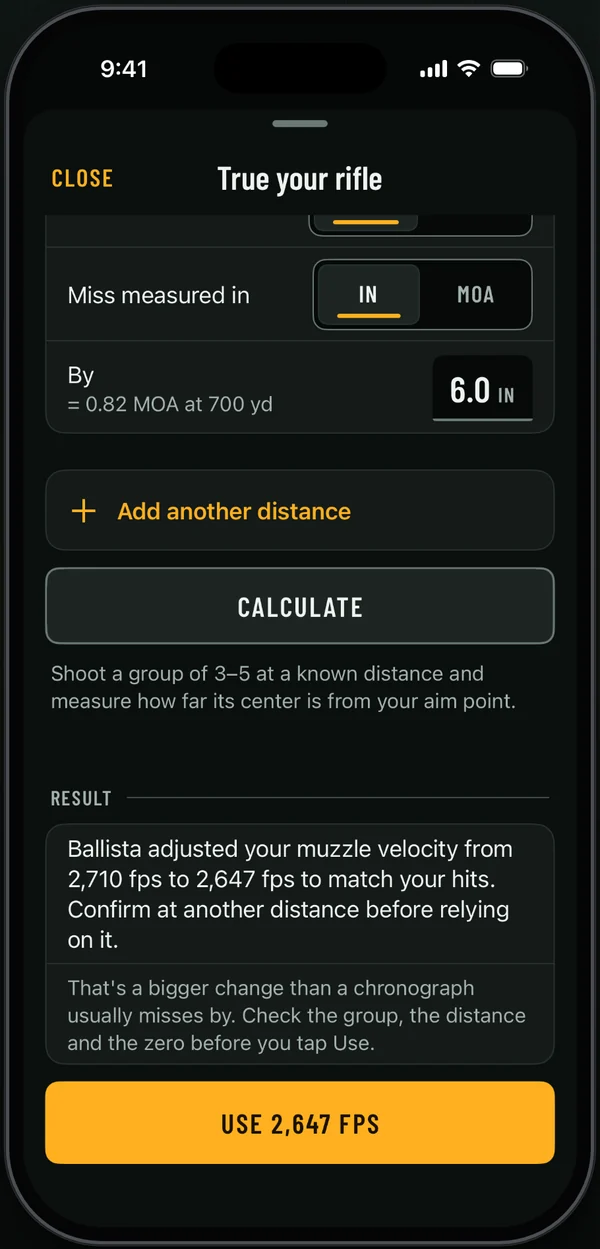
Ballista’s truing sheet looks for the same suspects, from the first distance you enter. Under “Why did I miss?” (or “Could also be” once there’s a result) it lists up to three inputs whose believable mistake alone would explain the whole miss, from “Muzzle velocity”, “BC”, “Sight height”, “Zero”, “Air temperature”, “Pressure”, “Turret” and “Distance”, each with how far off it would need to be and how to check it. A second and third distance, through “Add another distance”, are what separate the shapes. For pressure it says “Use station pressure, not a weather report.” Below half a MOA it doesn’t diagnose at all: “This miss is about what one group and half a click can do.”
Before you true: a checklist
- Zero. Confirm it on paper, and make sure the app’s zero distance matches the one you used.
- Sight height. Bore center to scope center, not the top of the scope.
- Air. Station pressure, not a weather report’s sea-level number. Today’s temperature.
- Velocity. Your chronograph, from your rifle, not the box.
- Turret. A tall-target test once per scope.
- Shoot two distances and compare the misses in MOA. The ratio points at what’s left.
- Then true the input the shape points to, at the distance that suits it: velocity in the middle, BC far out.
Sources
- Bryan Litz, Applied Ballistics for Long-Range Shooting, 3rd ed., Applied Ballistics LLC, 2015. Sensitivity of trajectories to velocity, BC and atmosphere; truing.
- Robert L. McCoy, Modern Exterior Ballistics, Schiffer Publishing, 1999. Point-mass trajectory and the sight-line geometry behind zero and sight height.
- Every number in this article: Ballista engine (BallistaCore point-mass solver), inputs in the box above. The sizes of the mistakes are our choices, stated in the text; the turret row is pure math, 5% of the come-up. See how we compute.