 Ballista
Calling Wind with a Bracket: Make the First Miss Measure the Wind
How wide a ±1.5 and ±3 mph wind bracket is in MIL from 300 to 1,000 yards, how to turn the first impact into a measured wind speed, and why you should carry miles per hour to the next target, not mils.
A first-round impact at 1,000 yards is a sensitive wind gauge. With a 6.5 Creedmoor, every 0.1 mil of horizontal miss at that distance is 0.5 mph of wind. At 300 yards the same 0.1 mil is 2.2 mph. The far shot magnifies your wind error, and that also makes it the best instrument you have for finding the real wind. A bracket is how you put that instrument to work.
What a wind bracket is
A wind call is never one number. You read mirage, flags and grass, and you end up with something like “10, maybe 8 or 12.” A bracket writes that down: the hold for your best call, plus the holds for the edges of what you believe. Hold the middle and the edges tell you the worst case before you break the shot. After the shot, the edges give you a scale to read the impact against.
The bracket is cheap to build because drift is proportional to the crosswind. Across every speed and range in this article, the engine’s wind hold matches “speed ÷ 10 × the 10 mph hold” to the thousandth of a mil. So a bracket of ±1.5 and ±3 mph around a 10 mph call is 15% and 30% of the 10 mph hold, at every range.
How wide the bracket is at each range
| Range, yd | 6.5: 10 mph hold | 6.5: ±1.5 mph | 6.5: ±3 mph | .308: 10 mph hold | .308: ±1.5 mph | .308: ±3 mph |
|---|---|---|---|---|---|---|
| 300 | 0.46 | ±0.07 | ±0.14 | 0.68 | ±0.10 | ±0.20 |
| 400 | 0.63 | ±0.09 | ±0.19 | 0.94 | ±0.14 | ±0.28 |
| 500 | 0.81 | ±0.12 | ±0.24 | 1.22 | ±0.18 | ±0.37 |
| 600 | 1.01 | ±0.15 | ±0.30 | 1.53 | ±0.23 | ±0.46 |
| 700 | 1.21 | ±0.18 | ±0.36 | 1.87 | ±0.28 | ±0.56 |
| 800 | 1.42 | ±0.21 | ±0.43 | 2.24 | ±0.34 | ±0.67 |
| 900 | 1.66 | ±0.25 | ±0.50 | 2.66 | ±0.40 | ±0.80 |
| 1,000 | 1.90 | ±0.29 | ±0.57 | 3.11 | ±0.47 | ±0.93 |
Two things matter here. For the 6.5, ±1.5 mph stays under one 0.1 mil click out to 400 yd; for the .308, out to 200 yd. In that zone a perfect call and a decent call dial the same number. From 700 to 1,000 yd, ±1.5 mph is 1.8 to 4.7 clicks, and ±3 mph on the .308 at 1,000 yd is ±0.93 mil, about 34 in either side of center. That’s where the bracket earns its place on the card.
Backing the wind out of the first impact
Here is the arithmetic in a worked example. You’re shooting the 6.5 at 800 yd. You call 10 mph from 3 o’clock and dial 1.27 mil right. The real wind is 13 mph. The shot lands 0.43 mil (12.3 in) left of your aim.
real wind = called wind + miss in MIL ÷ hold per mph at that range
At 800 yd the hold is 0.142 mil per mph, so the real wind is 10 + 0.43 ÷ 0.142 = 13.0 mph. The bracket on your card does this division for you. If the impact sits where the 13 mph hold would have centered the shot, the wind is 13.
Spin drift doesn’t spoil the method. It’s the same at a given range whatever the wind speed (0.15 mil at 800 yd here), so it sits inside every column of a full-hold bracket and cancels out of the difference. What does spoil it is any horizontal error that isn’t wind: a canted rifle, a poor wind-direction call, a shooter who pushed the shot. Read wind from a shot you trust. Vertical misses tell you about range, velocity or drag, apart from the small crosswind jump; the truing article deals with those.
Carry the wind to the next target, not the mils
Once you know the wind, express it as a speed. Say the 500 yd target showed you need 0.24 mil more than your 10 mph hold. You now move to 1,000 yd. If you add the same 0.24 mil to the 1,000 yd 10 mph hold, you dial 1.94. The 13 mph hold at 1,000 is 2.27. The carried correction leaves you 0.33 mil short, 12 in at the target.
A correction in mils is only good at the range where you saw it, because hold per mph more than doubles from 500 to 1,000 yd (0.081 to 0.190 mil). A wind speed is good at every range, as long as the wind is the same across the field.
Read the wind where it’s magnified
| Range, yd | 6.5: mph per 0.1 mil | 6.5: mph to miss a 12 in plate | .308: mph per 0.1 mil | .308: mph to miss a 12 in plate |
|---|---|---|---|---|
| 300 | 2.2 | 12.0 | 1.5 | 8.2 |
| 500 | 1.2 | 4.1 | 0.8 | 2.7 |
| 600 | 1.0 | 2.8 | 0.7 | 1.8 |
| 800 | 0.7 | 1.5 | 0.4 | 0.9 |
| 1,000 | 0.5 | 0.9 | 0.3 | 0.5 |
The two columns for each rifle show the same thing from two sides. Near targets need a rough call and reveal little: at 300 yd a miss of one click means the wind was off by 2.2 mph, and the 6.5’s call can be 12 mph off before a center hold leaves a 12-inch plate. Far targets need a precise call and reveal a lot. With the .308 at 1,000 yd, the call has to be within 0.5 mph to keep a center hold on that plate, but each click of miss is only 0.32 mph of wind.
That gives a practical order on a multi-target stage. When conditions allow, let a far impact set the wind and work back toward the near targets with that speed.
Why a bracket beats a single guess
Shoot a single guess and miss, and you know which way you were wrong but not by how much, so the second shot is another guess. Shoot with a bracket and the miss already has a scale next to it. For the 6.5 at 1,000 yd, a ±3 mph uncertainty is ±0.57 mil, 21 in either side. If you can spot your impact to the nearest 0.1 mil, the miss narrows the wind to about ±0.3 mph, and the follow-up carries no more than half a click (0.05 mil) of wind error. The catch is time. The measurement describes the wind during that shot, so the follow-up has to come before the wind changes.
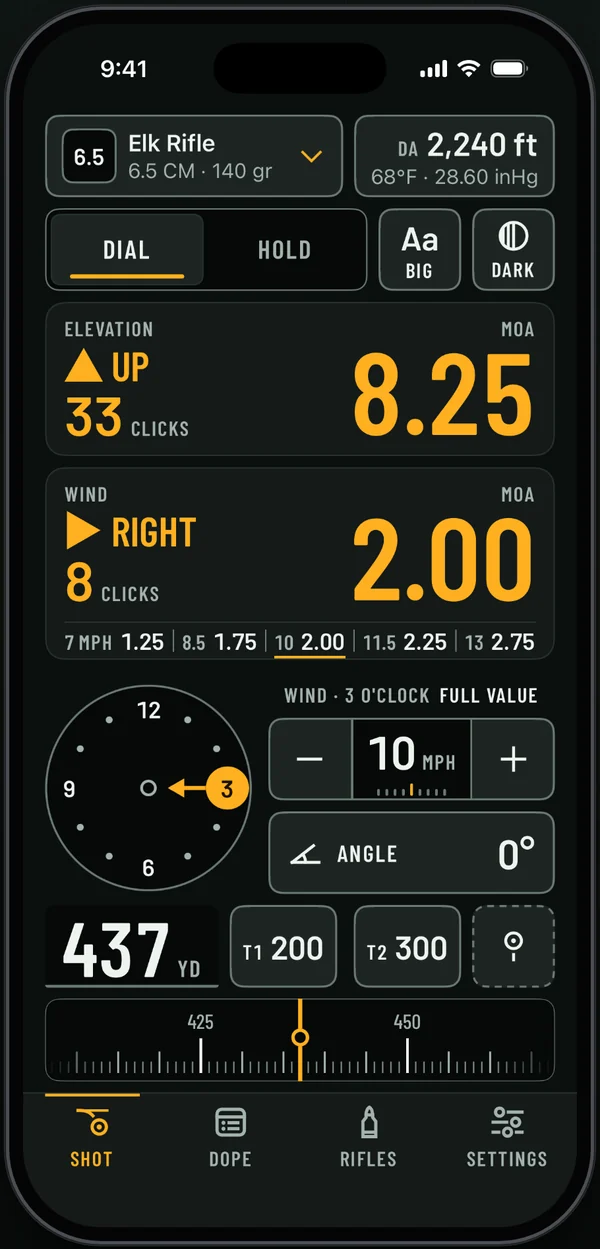
Ballista builds this bracket on the Shot screen. On the DIAL face, a strip under the wind answer shows the full hold at your wind minus 3 and 1.5 mph, at your wind, and at plus 1.5 and 3 mph, all from the direction you set and with spin drift included. Speeds below zero are left out, and the strip is hidden when every column rounds to the same click, as in a headwind. On the HOLD face, the reticle carries small ticks at the minus 3 and plus 3 mph holds.
A bracket routine
- Make your best call, then set the edges you believe: usually ±1.5 or ±3 mph.
- Look at the bracket width before you shoot. If ±1.5 mph is under a click, don’t spend time refining the call.
- Hold the middle. Watch the trace or the impact and note where it landed in mils.
- Convert the miss to a wind speed with your hold per mph, or read the column it matches.
- Carry that speed, not the mils, to the next distance, and shoot the follow-up quickly.
For how drift itself scales with range and bullet, see the wind drift article. For winds that aren’t from 3 or 9 o’clock, use the wind angles article to turn speed and direction into a full-value speed first.
Sources
- Bryan Litz, Applied Ballistics for Long-Range Shooting, 3rd ed., Applied Ballistics LLC, 2015. Wind deflection and spin drift.
- Robert L. McCoy, Modern Exterior Ballistics, Schiffer Publishing, 1999. Crosswind deflection.
- Every number in this article: Ballista engine (BallistaCore point-mass solver), inputs in the box above. See how we compute.