 Ballista
Wind Drift: Why Lag Time, Not Time of Flight, Sets Your Hold
Why a 6.5 Creedmoor drifts 39% less than a .308 while spending only 16% less time in the air, how to learn one wind number per range, and what a 2 mph wrong call costs at 600 and 1,000 yards.
Put a 6.5 Creedmoor and a .308 side by side in a 10 mph wind blowing straight across the range. At 1,000 yards the 6.5 is in the air for 1.50 seconds and the .308 for 1.79. That is 16% less time. Yet the 6.5 drifts 68 inches and the .308 drifts 112, which is 39% less. If wind simply carried the bullet along for the ride, those two percentages would match. They don’t, because the wind never carries the bullet. It works through drag, and the quantity that sets drift is lag time.
The bullet doesn’t ride the wind
Air resistance acts along the bullet’s velocity relative to the air. In still air that’s straight back along its path. In a crosswind the air itself is moving sideways, so the relative airflow arrives slightly from the side and drag gets a small sideways component. That sideways part of drag is the only thing pushing the bullet off line. A bullet with no drag at all would fly straight through a crosswind untouched, and a bullet that loses velocity quickly gets pushed hard.
This gives a compact result that ballisticians have used since the 19th century, usually credited to Isidore Didion and derived in modern form in McCoy’s Modern Exterior Ballistics. For a crosswind that is the same all the way to the target:
drift = crosswind speed × (time of flight − range ÷ muzzle velocity)
The term in brackets is the lag time: how much longer the bullet takes than it would if it kept its muzzle velocity all the way. Here is the formula next to the full solution from the Ballista engine, which integrates the trajectory step by step and doesn’t use the formula at all.
| Range, yd | Time of flight, s | Range ÷ muzzle velocity, s | Lag time, s | 10 mph × lag, in | Engine drift, in |
|---|---|---|---|---|---|
| 100 | 0.114 | 0.111 | 0.003 | 0.5 | 0.5 |
| 200 | 0.234 | 0.221 | 0.012 | 2.2 | 2.2 |
| 300 | 0.360 | 0.332 | 0.028 | 5.0 | 5.0 |
| 400 | 0.495 | 0.443 | 0.052 | 9.1 | 9.1 |
| 500 | 0.637 | 0.554 | 0.083 | 14.6 | 14.6 |
| 600 | 0.788 | 0.664 | 0.123 | 21.7 | 21.7 |
| 700 | 0.948 | 0.775 | 0.173 | 30.4 | 30.4 |
| 800 | 1.119 | 0.886 | 0.233 | 41.0 | 41.0 |
| 900 | 1.301 | 0.996 | 0.305 | 53.6 | 53.6 |
| 1,000 | 1.496 | 1.107 | 0.389 | 68.5 | 68.5 |
The two columns agree to within a tenth of an inch at every range. So for a flat shot, the lag rule is the physics of wind drift, not a rule of thumb.
Why the 6.5 drifts so much less
Time of flight barely separates the two cartridges. Lag time does.
Both bullets leave the muzzle at similar speeds, so the vacuum part of the bar is similar. The difference is velocity retention. The 140 gr 6.5 mm bullet has a higher G7 ballistic coefficient (0.326 against 0.243) and keeps more of its speed, so it falls behind schedule more slowly. Muzzle velocity helps only through the same door: a faster bullet shortens time of flight, but it pays off in drift only if lag time shrinks too.
This is also why ballistic coefficient, not muzzle velocity, is what shooters chase for wind. The velocity versus BC article shows the same split for elevation.
One number per range: your 10 mph hold
At these speeds drift is proportional to the crosswind. The engine gives 34.2 in at 5 mph, 68.5 in at 10 mph and 102.7 in at 15 mph at 1,000 yd: half and one and a half times the 10 mph number, to the tenth of an inch. That means you need to remember one value per range, the hold for a 10 mph full-value wind, and scale it.
| Range, yd | 6.5 CM, MIL | 6.5 CM, MOA | .308, MIL | .308, MOA |
|---|---|---|---|---|
| 200 | 0.30 | 1.03 | 0.44 | 1.50 |
| 300 | 0.46 | 1.59 | 0.68 | 2.33 |
| 400 | 0.63 | 2.18 | 0.94 | 3.23 |
| 500 | 0.81 | 2.80 | 1.22 | 4.20 |
| 600 | 1.01 | 3.46 | 1.53 | 5.27 |
| 700 | 1.21 | 4.15 | 1.87 | 6.43 |
| 800 | 1.42 | 4.90 | 2.24 | 7.72 |
| 900 | 1.66 | 5.69 | 2.66 | 9.14 |
| 1,000 | 1.90 | 6.54 | 3.11 | 10.71 |
A common way to carry this is a “wind number” for each range band: the hold in MIL or MOA for 10 mph. If the 6.5 holds 1.0 mil at 600 yd in 10 mph, then a 6 mph call is 0.6 mil. The arithmetic is easy. The call is hard.
What a wrong call costs
Suppose you call 10 mph and the real wind is 8 or 12. For the 6.5 that 2 mph error is 4.3 in (0.20 mil) at 600 yd and 13.7 in (0.38 mil) at 1,000. A 12-inch steel plate gives you 6 inches either side of center. At 600 yd a 2 mph error still hits. At 1,000 it misses, before you count any other error.
Litz’s weapon-employment-zone analyses reach the same conclusion from a full error budget: at long range the wind call is usually the largest single source of misses, larger than a typical muzzle velocity spread or a small ranging error. That’s why experienced shooters treat the first shot as a measurement. They hold for their best call, watch the impact or the trace, and correct with the next one.
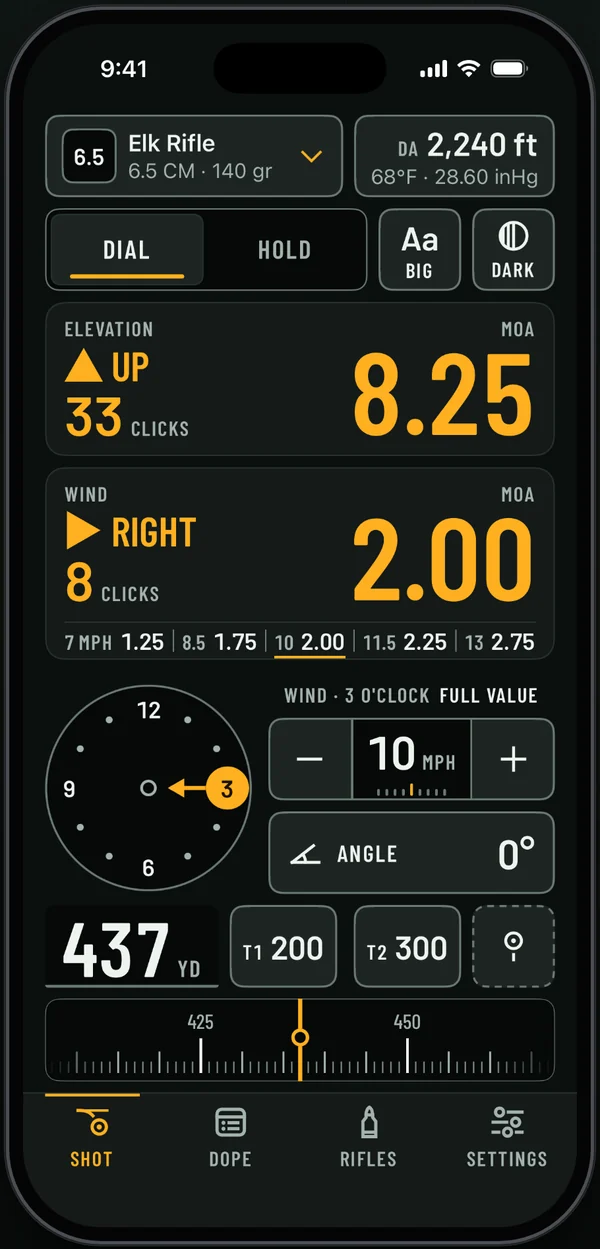
Ballista puts that bracket on the Shot screen. Under the wind hold it shows the hold for your call plus and minus 1.5 and 3 mph, so you can see before the shot how far a misjudged gust moves you, and after a miss you can read off which wind the impact fits.
Same wind, two different holds
Bullets fired from a right-hand twist barrel drift right on their own. That’s spin drift, covered in its own article. It means wind from the left and wind from the right are not mirror images. For the 6.5 at 1,000 yd in 10 mph:
- Wind from 3 o’clock pushes the bullet left, spin drift pushes it right: the net is 61.1 in left.
- Wind from 9 o’clock pushes it right, and spin drift adds: 75.9 in right.
That’s a 14.8 in difference from spin drift alone (7.4 in counted twice). If you learned your holds in a right-to-left wind and simply mirror them, you’ll be off by that much at distance. A solver that includes spin drift handles both directions correctly.
The vertical part of a crosswind
A crosswind also moves the impact up or down. When wind hits a spinning bullet from the side, the bullet’s nose yaws briefly as it leaves the muzzle, and that sets it off on a slightly different vertical angle. Litz measured and modeled this as aerodynamic jump. With right-hand twist, wind from the right moves impacts down and wind from the left moves them up.
For the 6.5 in a 10 mph wind from 3 o’clock the engine gives 0.37 in low at 100 yd and 3.7 in low at 1,000 yd. That’s a nearly constant angle of about 0.36 MOA. It’s small, but in a strong full-value wind it’s the reason a perfect wind hold can still land low on one side of the plate.
A short field routine
- Know your 10 mph hold at three or four ranges for each load you shoot. Write them on your DOPE card.
- Call the wind as a full-value speed: the speed times how much of it is crossing. The wind angles article covers that.
- Hold for your best call, then read the first impact against the bracket. A miss that lands where the 13 mph hold would have put it tells you the wind is 13.
- Let the solver handle spin drift, jump and direction. The arithmetic isn’t where shots are lost.
Sources
- Robert L. McCoy, Modern Exterior Ballistics, Schiffer Publishing, 1999. Crosswind deflection and the lag-time result.
- Bryan Litz, Applied Ballistics for Long-Range Shooting, 3rd ed., Applied Ballistics LLC, 2015. Wind deflection, spin drift and aerodynamic jump.
- Bryan Litz, Accuracy and Precision for Long Range Shooting, Applied Ballistics LLC, 2012. Error budgets and hit probability.
- Every number in this article: Ballista engine (BallistaCore point-mass solver, RK4), inputs listed in the box above. See how we compute.